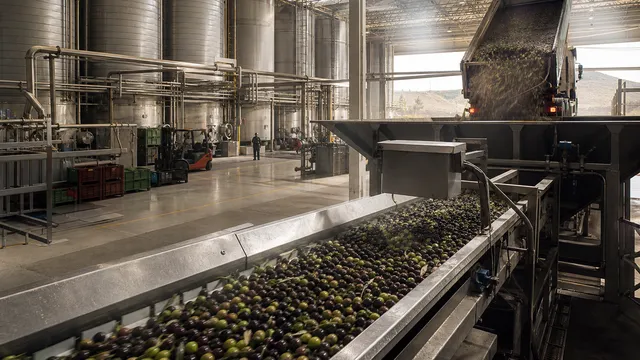
The 2023/24 season rules of the Archidona cooperative, in Málaga, take up three pages. Unloading opens Monday to Saturday, from eleven to one and from two to six. Members must follow staff instructions about which hopper is theirs and their place in the queue. Tree-picked olives are delivered daily, separate from ground olives. And the whole crop must be brought in, or there will be a penalty. What the rules never say is which day each member should harvest: that is up to them.
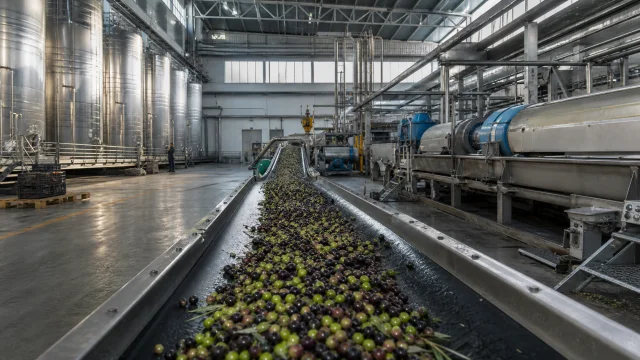
At large cooperatives, peak days are solved with concrete and steel. San Isidro de Loja, in Granada, with around 1,400 members, has thirty working hoppers, can receive up to two million kilos of olives a day and needs shifts, even at night, during the season.
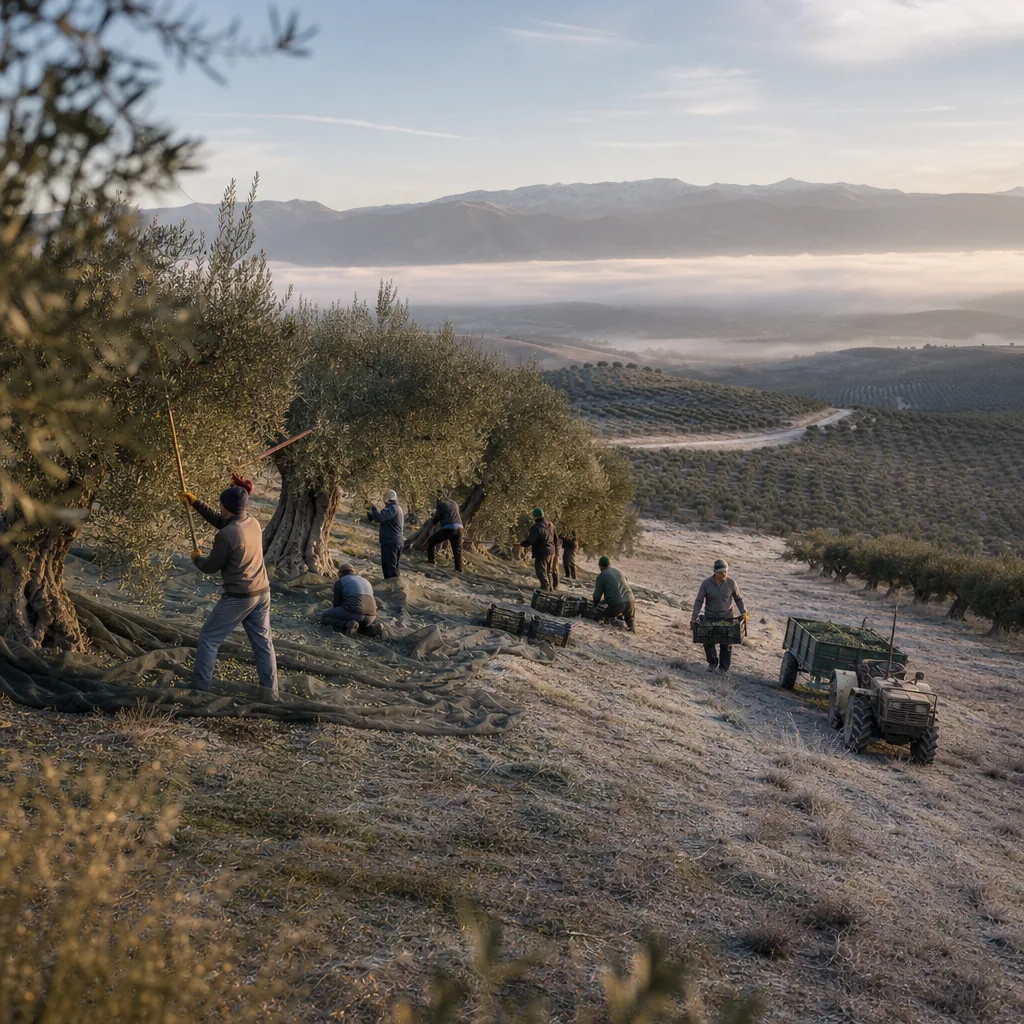
When each member picks their date on their own, nobody sees the whole. If many coincide, crews become scarce, the queue of trailers grows and the olives wait before being milled, losing quality. That is the scenario we reproduce in our simulation: there we assume that almost everyone starts around 20 November, like their neighbours. It is an assumption of the model, not measured data, and it will have to be checked against a real cooperative’s delivery history.
The question we asked ourselves at Olearia is whether a cooperative could do better without taking away anyone’s freedom to decide: with advice, a plan each member can follow or not. And, above all, what happens to each member when the whole gains.
Two plots, one mill
Let us start small. One crew and one mill that can harvest and mill one plot a day. Two plots ready. If plot A waits a day, it loses €100 of value; if B waits, it loses €400. The figures are made up, to show the mechanism.
Who harvests today?
One crew and one mill. Capacity to harvest and mill one plot a day.
With A first, B waits: €400 is lost.
- Change for A
- €0
- Change for B
- €0
- Joint improvement
- €0
If A goes first, B waits and €400 is lost. If B goes first, €100 is lost. The same mill and the same crew keep €300 more just by changing the order. But A comes off worse than in the first order: now it is A that waits. If B passes €150 to A, both come out ahead. The order creates the value; the split decides who takes it.
All the research that follows is this example multiplied: hundreds of members, thousands of plots, rain, crews that do not turn up and a mill with a limit. And the same underlying tension: what suits the whole does not always suit each one.
With three members you can already see it. Three neighbours with Picual, whose farms ripen in different weeks, and a single crew. Today they all call at once and the crew goes in order of calls. Coordinated, each one starts when their olives reach their point.
Overripe: on the ground and lower grade
At its best
At its best
At its best
Green: less oil and more labour
At its best
- What their olives are worth each day
- Crew at the right time
- Crew at the wrong time
The rest is for key holders
The background is open. We share the results, the figures and the full exam with the cooperatives, olive mills and research teams we work with.
Don't have a key? Ask us for one
 Grower
 Olearia Agritech The olive grove app: official field book, crew, machinery, satellite, weather and accounts per farm. Ready for the 2027 digital field book Works without signal Free up to 10 ha of olive grove See Agritech