Farmer driving a tractor between olive trees with dust in the air

Use cases

Everyday problems, solved step by step

How each platform handles daily work in cooperatives, mills and farms. Typical cases from the sector, not customers.

Olearia Intelligence

Market data for informed decisions

Olive oil cooperative

400–600 members · 2–5 million kg per season · direct marketing

The situation

The manager of a mid-sized cooperative in Jaén or Córdoba decides when to sell the season's oil. The method: call three brokers, look at last year's price and decide. In a market where weekly volatility exceeds 5%, that decision is worth a lot of money.

With Olearia Intelligence

  1. Every Monday they check the Intelligence dashboard: current price against the historical average for seasons with similar output.
  2. They review Copernicus climate signals: water stress in Italy or Greece can cut European output and push prices up.
  3. They compare their production costs —energy, fertiliser, transport— with the EU-4 average and know their real margin.
  4. They look at probabilistic scenarios at 30, 60 and 90 days: not a single forecast but a range with probabilities to size the risk.
  5. They go into the broker negotiation with the same information as the big operators.

Sell when the data says so, not on instinct.

For CooperativesMarketing companiesSales managers
Packer and exporter

5,000–15,000 t a year · exports to 5–10 countries · own brand or private label

The situation

A Spanish exporter competes with Italy, Greece and Tunisia in the same markets. They need to know when to buy at origin, what price to sell at destination and where demand is growing before others notice. Today they rely on reports that arrive weeks late and on their network of contacts.

With Olearia Intelligence

  1. Trade flows for 220 countries: who is buying more, who is selling less and where an opportunity opens. Official customs data, not estimates.
  2. Prices by origin —Spain, Italy, Greece, Portugal, Türkiye, Tunisia— to spot differentials between markets.
  3. Risk analysis with VaR, volatility and scenario simulation to size purchases without overexposure.
  4. Alerts when a key variable changes: revised output in a producing country, demand from a large importer or a sharp price move at an origin.

A view of 220 countries, updated every month.

For ExportersPackersCommercial directors

Olearia Digital Twins

Full control of the olive mill

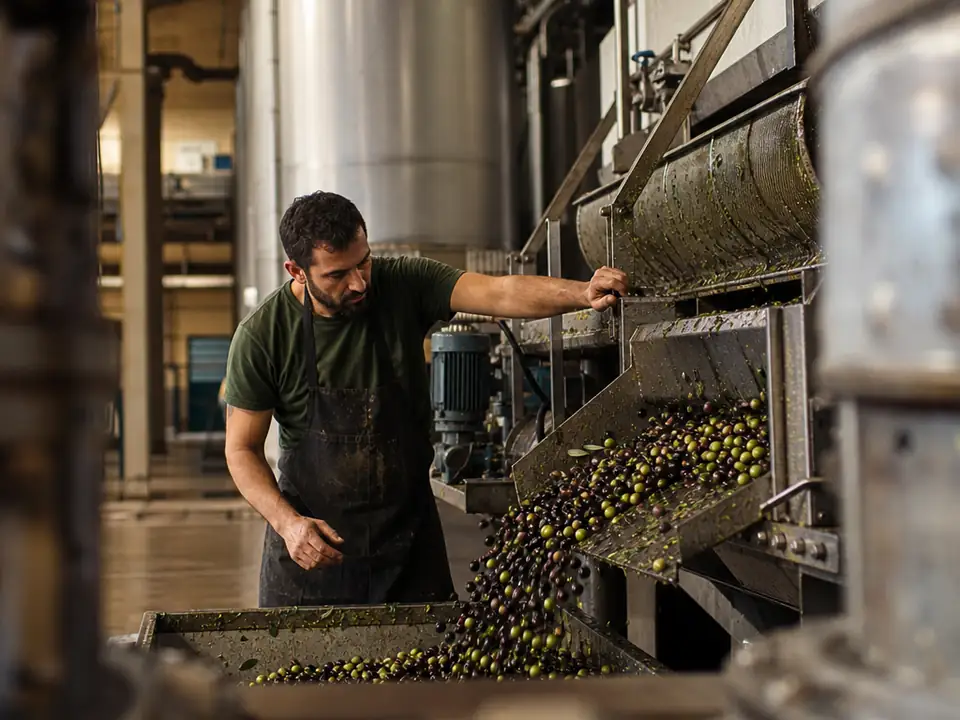
Three-line olive mill

3 lines · 200–400 t a day · season from October to February

The situation

A mid-sized mill runs at full capacity three or four months a year. Every hour of unplanned downtime during the season leaves 25 to 35 tonnes of olives unmilled, and fruit that waits loses quality.

With Olearia Digital Twins

  1. The 3D digital twin shows the plant's zones on a single screen: temperatures, pressures and flows of the three lines without leaving the desk.
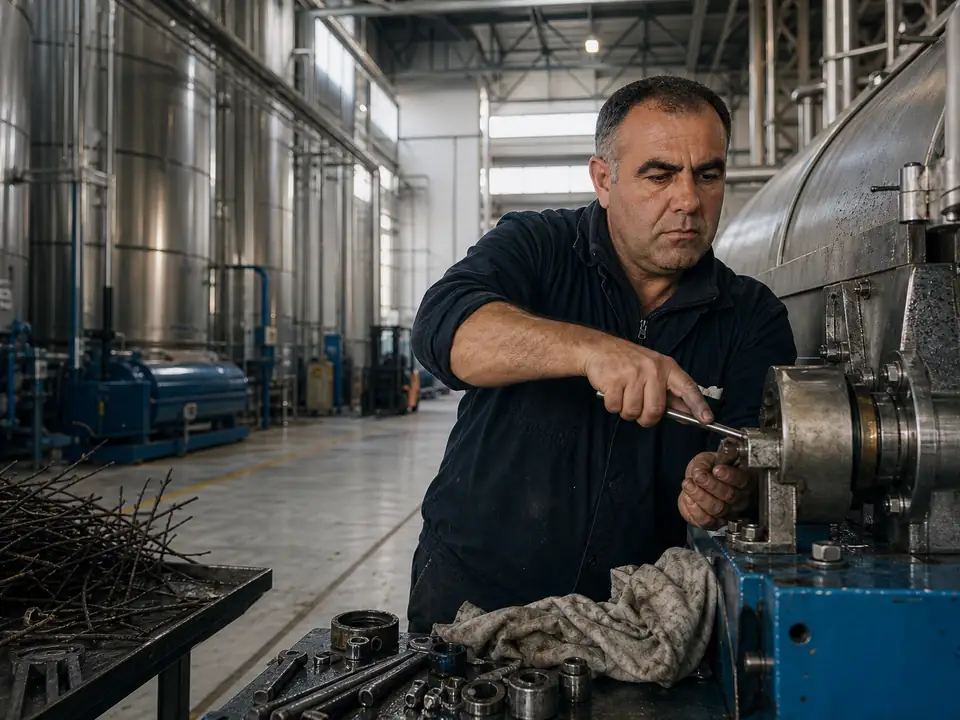
  2. Each machine's vibration is tracked against its normal zones: a drift in the decanter shows up before it stops the line.
  3. Alerts arrive prioritised: what to check and how urgently. Not fifty warnings a day, just the ones that matter.
  4. Performance per line —kilos milled per hour and oil per kilo of olives— to find the bottlenecks.
  5. Batch traceability: the process conditions of every batch are recorded and IFS/BRC audits stop taking weeks.

Less downtime, because you see the fault coming.

For Plant managersProduction directorsQuality managers

Certified olive mill

PDO · PGI · IFS · BRC · growing ESG requirements · exports within the EU

The situation

Quality and food-safety certifications demand full process traceability, and large European retailers ask for energy, carbon-footprint and waste data. Preparing an audit means weeks of cross-checking records by hand.

With Olearia Digital Twins

  1. Every batch keeps its process conditions —temperatures, times, pressures— from reception to the cellar, with no manual work.
  2. ESG indicators calculated automatically: energy per line, water efficiency and an estimated carbon footprint.
  3. Audit reports in minutes: the data is already structured and only needs exporting in the format the auditor asks for.
  4. Season history to prove continuous improvement, increasingly required by demanding certifications.

The audit ready before the auditor arrives.

For Quality managersOperations directorsCertification bodies

Olearia Agritech

Professional grove management

Professional grower

50–300 ha · traditional or intensive grove · 1–3 employees

The situation

150 hectares mean 8 to 12 treatments a year, plus fertilising, irrigation and field work. Every operation is logged with product, dose, date, plot and technical justification, and from 2027 plant-protection records are no longer valid on paper in Spain.

With Olearia Agritech

  1. They finish a treatment, take out their phone, pick the operation and the plot, and confirm. Under a minute, even with no signal.
  2. They always see their compliance level: which signatures, justifications or deadlines are missing, without checking by hand.
  3. The AI adviser flags the application window based on the weather and the state of the trees in their area.
  4. Sentinel-2 imagery every 5 days points to the parts of their plots with water stress or low vigour.
  5. At the end of the season they have output, costs and yield per plot; if they share plots with other owners, the accounts add up on their own.
  6. If an inspection comes, they export to SIEX, XML or PDF in one click.

An up-to-date logbook, logging in the field in under a minute.

For GrowersAgronomistsField cooperatives

Farm with many plots

Over 200 ha · several varieties · co-ownership or tenancy

The situation

A farm with 20 or 30 plots split between owners and tenants has to keep production, costs and distribution transparent. Each plot has its own variety, age and yield, and today everything lives in spreadsheets that everyone reads differently.

With Olearia Agritech

  1. Every plot with its record: satellite map with NDVI, land registry, variety, density and production history.
  2. Costs and output per plot, with yield calculated and the real margin at market prices.
  3. Multiple users with permissions: each owner sees their plots, the agronomist sees all of them and the worker logs the tasks.
  4. Expiry alerts for machinery documentation (roadworthiness, sprayer inspection, certificates).
  5. With co-ownership, the numbers are the same for everyone.

Output, costs and distribution in one place.

For Multi-plot farmsJoint ownershipsAgricultural partnerships

Try it

The best way to check is to use it

Agritech is free up to 10 ha; Intelligence and Digital Twins open by invitation.

Viento del pueblo · 1937

Aceituneros

Miguel Hernández

Andaluces de Jaén,
aceituneros altivos,
decidme en el alma: ¿quién,
quién levantó los olivos?

No los levantó la nada,
ni el dinero, ni el señor,
sino la tierra callada,
el trabajo y el sudor.

Unidos al agua pura
y a los planetas unidos,
los tres dieron la hermosura
de los troncos retorcidos.

Levántate, olivo cano,
dijeron al pie del viento.
Y el olivo alzó una mano
poderosa de cimiento.

Andaluces de Jaén,
aceituneros altivos,
decidme en el alma, ¿quién
amamantó los olivos?

Vuestra sangre, vuestra vida,
no la del explotador
que se enriqueció en la herida
generosa de sudor.

No la del terrateniente
que os sepultó en la pobreza,
que os pisoteó la frente,
que os redujo la cabeza.

Árboles que vuestro afán
consagró al centro del día
eran principio de un pan
que sólo el otro comía.

¡Cuántos siglos de aceituna,
los pies y las manos presos,
sol a sol y luna a luna,
pesan sobre vuestros huesos!

Andaluces de Jaén,
aceituneros altivos,
pregunta mi alma: ¿de quién,
de quién son estos olivos?

Jaén, levántate brava
sobre tus piedras lunares,
no vayas a ser esclava
con todos tus olivares.

Dentro de la claridad
del aceite y sus aromas,
indican tu libertad
la libertad de las lomas.

Tell us

Building the future of olive oil, together.

Type